
Cumulative vs Non-Cumulative FD Explained
When you book a fixed deposit, one choice matters as much as the rate: how interest is paid. Cumulative FDs reinvest interest until maturity; non-cumulative FDs pay it out on a schedule.
Start with What is Fixed Deposit? if you are new. For how interest grows over time, see Simple vs Compound Interest. Then test both options in our FD Calculator.
On this page
What Is a Cumulative FD?
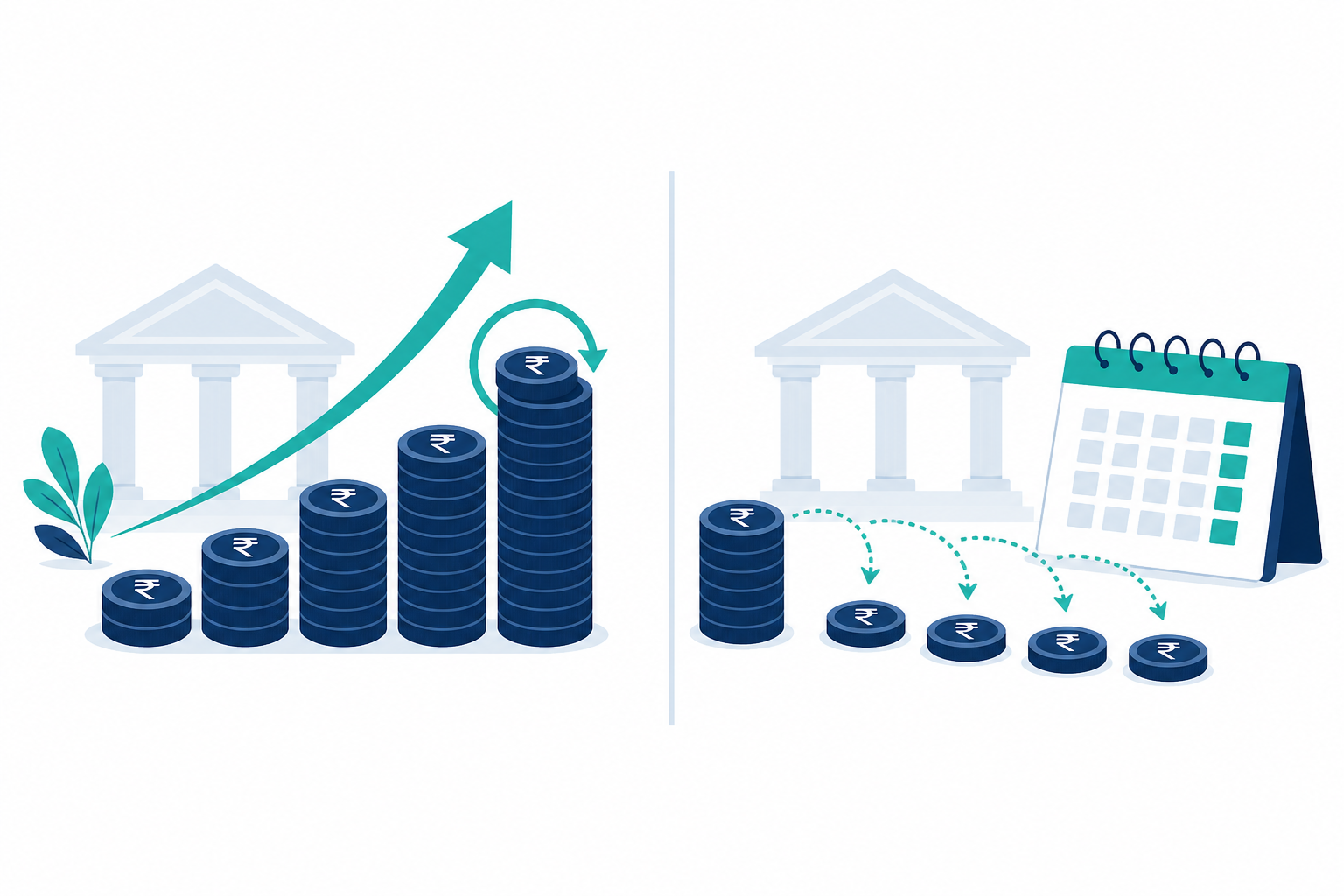
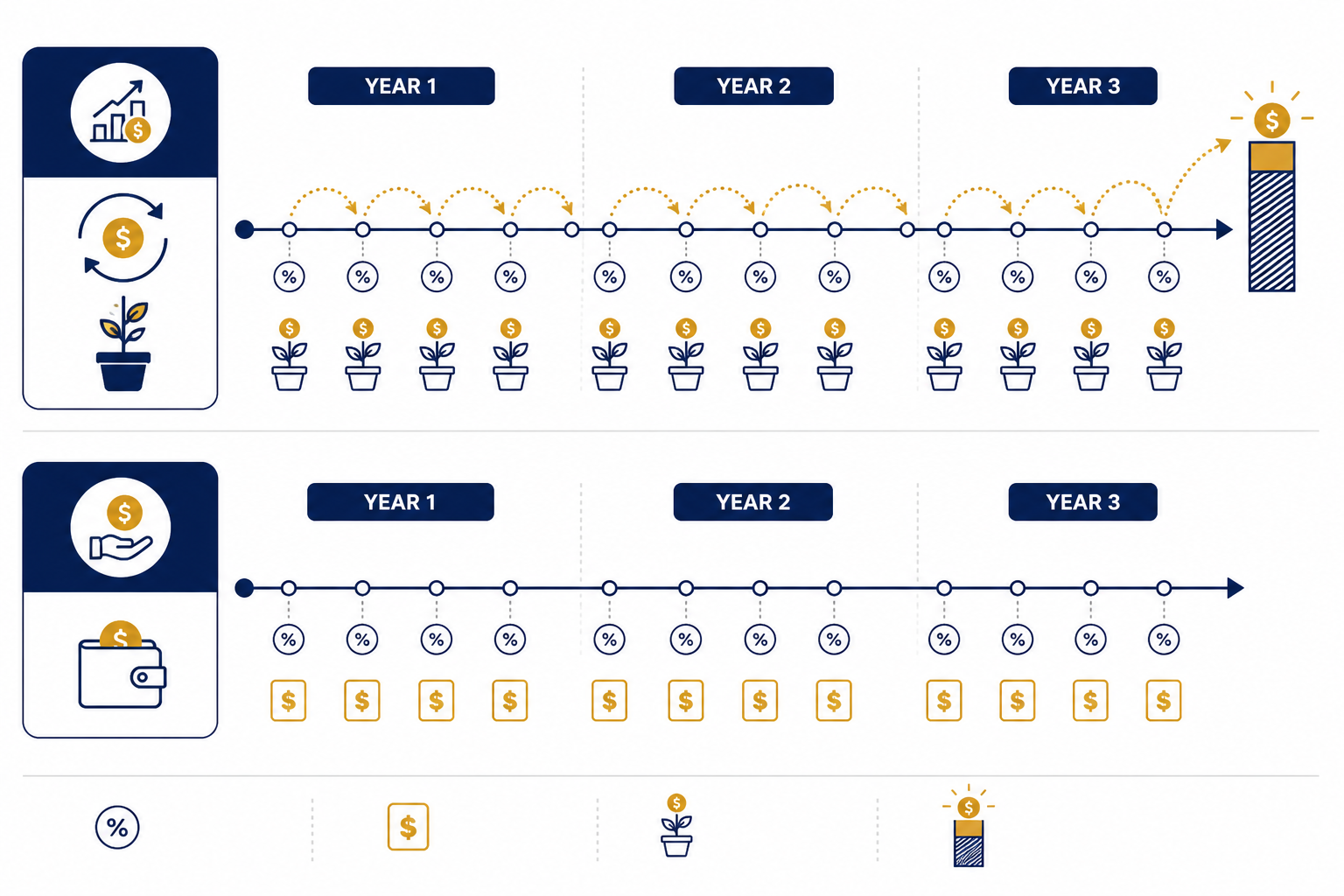
A cumulative fixed deposit keeps all interest inside the deposit until maturity. The bank adds interest to the principal at set intervals (often quarterly), and that combined amount earns further interest for the rest of the tenure.
At maturity, you receive one lump sum: your original deposit plus all compounded interest. This is why cumulative FDs are also called reinvestment or compounding deposits.
- Best for: Long-term goals where you do not need periodic income
- Cash flow: No interest credits until maturity
- Return profile: Usually the highest maturity value for the same quoted rate
If your goal is to maximize the final amount, cumulative is often the default choice. Learn more about compounding mechanics in our compound interest guide.
What Is a Non-Cumulative FD?
A non-cumulative fixed deposit pays interest to your linked account on a fixed schedule—monthly, quarterly, half-yearly, or annually—while the principal stays locked until maturity.
Each payout gives you usable cash without breaking the FD. However, because interest leaves the deposit, you miss the full reinvestment benefit that cumulative FDs provide over the same tenure.
- Best for: Regular income needs (retirees, household budgets)
- Cash flow: Predictable interest credits on a calendar
- Return profile: Lower total interest than cumulative for the same rate
Non-cumulative FDs are popular when liquidity of income matters more than maximizing the final lump sum. Compare with FD vs Savings Account if you are weighing daily access against fixed tenure.
Key Differences at a Glance
| Feature | Cumulative FD | Non-Cumulative FD |
|---|---|---|
| Interest payout | At maturity only | Monthly, quarterly, half-yearly, or yearly |
| Principal access | Locked until maturity (unless broken early) | Locked until maturity (unless broken early) |
| Total interest earned | Usually higher over full tenure | Usually lower because interest is paid out |
| Income timing | Back-loaded (one payment at end) | Front-loaded through the tenure |
| Typical use case | Goal-based savings, wealth building | Retirement income, regular cash top-ups |
| Tax on interest | Taxable when credited or at maturity (bank rules vary) | Taxable each time interest is credited |
Cumulative FD
- Interest reinvested until maturity
- Highest lump-sum outcome
- No periodic income
- Suits 2–5 year goals
- Best for: Growth-focused savers
Non-Cumulative FD
- Interest paid on a schedule
- Steady cash flow during tenure
- Lower total interest vs cumulative
- Monthly or quarterly options common
- Best for: Income-focused savers
Monthly, Quarterly & Annual Payouts
Non-cumulative FDs come in several payout frequencies. Banks may quote slightly different effective rates depending on how often interest is paid—the more frequent the payout, the lower the effective yield compared with annual or cumulative reinvestment.
Monthly payout
Interest credited every month. Useful for household budgets and retirees who need steady income.
Quarterly payout
A common middle ground. Cash arrives four times a year with less admin than monthly credits.
Annual payout
One interest payment per year. Closer to cumulative returns while still providing some periodic income.
When comparing bank rate cards, check whether the published rate assumes cumulative compounding or a specific payout mode. See how FD interest rates are set and bank-specific pages such as HDFC FD rates or SBI FD rates.
Worked Example: Same Rate, Different Outcome
Suppose you deposit ₹5,00,000 at 7% p.a. for 3 years. The numbers below are illustrative—actual bank calculations may use day-count conventions and rounding rules.
| Option | Approx. total interest | Approx. maturity value | Cash flow during tenure |
|---|---|---|---|
| Cumulative (quarterly compounding) | ~₹1,15,000 | ~₹6,15,000 | None until year 3 |
| Non-cumulative (monthly payout) | ~₹1,05,000 | ₹5,00,000 principal returned | ~₹2,900/month interest |
| Non-cumulative (quarterly payout) | ~₹1,06,000 | ₹5,00,000 principal returned | ~₹8,750/quarter interest |
The cumulative option leaves roughly ₹10,000+ more in total interest over three years in this example—because every rupee of interest keeps earning. Run your own numbers in the FD Calculator or a bank tool like the HDFC FD Calculator.
When to Choose Which Option
Choose cumulative when…
- You are saving for a future goal (education, home down payment, wedding)
- You do not need interest income during the tenure
- You want the highest possible maturity amount from a fixed rate
- You are building a ladder where each rung reinvests at maturity—see FD Laddering Strategy
Choose non-cumulative when…
- You need regular income without selling investments or breaking FDs
- You are retired or semi-retired and budget from interest credits
- You prefer predictable monthly or quarterly cash to reinvest elsewhere
- You want FD safety but cannot lock away all spendable income
Many savers use both: cumulative FDs for long goals and non-cumulative FDs for near-term income. If tax deduction on principal matters, a separate Tax Saver FD under Section 80C follows its own 5-year lock-in rules.
Tax & TDS Considerations
FD interest is generally taxable as income under applicable tax rules, regardless of payout mode.
- Cumulative FD: Interest may be taxed when credited to your account or at maturity, depending on bank practice and your tax reporting approach.
- Non-cumulative FD: Interest is taxable in the year it is credited—each monthly or quarterly payment counts toward your total income.
- TDS: Banks may deduct TDS when total FD interest crosses yearly thresholds. Senior citizens often have higher limits. Track interest across all deposits, not just one FD.
For Section 80C principal deduction (not interest exemption), read Tax Saver FD Explained. Tax rules change—verify current limits with official sources or a tax professional.
Smart Tips
- Match payout to your budget calendar. If bills are monthly, a monthly payout FD may fit better than quarterly.
- Compare effective yield, not just headline rate. A 7% cumulative rate and a 7% monthly payout rate do not produce identical outcomes.
- Split across both types. Keep growth money in cumulative FDs and income money in non-cumulative FDs.
- Align tenure with cash needs. Non-cumulative FDs still lock principal—plan emergency cash separately in a savings account.
- Check senior citizen rates. If you qualify, the extra rate applies to both cumulative and payout variants at most banks.
- Confirm payout mode at booking. Banks usually cannot switch modes on an active FD; choose correctly upfront.
Common Mistakes
Picking monthly payout for a growth goal
If you will not spend the interest, cumulative reinvestment typically earns more over the same tenure.
Assuming payout FDs are fully liquid
Only interest is paid out. Principal stays locked, and early withdrawal may still carry penalties.
Ignoring tax on small payouts
Monthly credits add up. Track total yearly interest for tax filing and TDS thresholds.
Comparing unlike rate quotes
Always check whether a bank’s published rate is for cumulative or payout FDs before deciding.
Frequently Asked Questions
Which FD type gives higher returns: cumulative or non-cumulative?
For the same principal, rate, and tenure, a cumulative FD usually pays more at maturity because interest stays invested and compounds. Non-cumulative FDs pay interest out on a schedule, so the final lump sum is typically lower.
Can I switch from cumulative to non-cumulative after booking?
Most banks do not allow you to change payout mode on an existing FD. You usually need to book a new deposit with the payout option you want.
Is non-cumulative FD interest taxed differently?
No. FD interest is generally taxable as income in both cases. With non-cumulative FDs, tax is due each year when interest is credited, even though principal stays locked.
Who should pick monthly payout FDs?
Monthly payout FDs suit retirees or anyone who needs regular cash flow from savings without breaking the deposit early.
Does compounding still matter in non-cumulative FDs?
Banks may still compound internally for rate calculation, but because interest is paid out, you do not get the full reinvestment benefit that a cumulative FD provides.
Can I use an FD calculator for both types?
Yes. Run one scenario with interest reinvested to maturity, then compare with periodic payout assumptions to see total interest and cash-flow timing.