
Axis Bank FD Calculator Online with Interest Rates in 2026
Fixed Deposits are the backbone of savings in India. In fact, over 24.23 million fixed deposits are active across the country, with more than ₹103 trillion locked in them. That’s an incredibly large figure. Yet most people still struggle to know how much their FD will earn.
That is exactly where the Axis Bank FD Calculator comes in.
This simple online tool gives you instant answers. Only precise results within seconds.
Between ₹5,000 and ₹2,99,99,999 (typical retail band).
1 year
Years
Months
Use your bank’s published FD rate card for the slab that matches your tenor, or read our FD interest rates guide for context—then enter the rate here.
- Rate of interest*
- 7.10%
- Date of fixed deposit
- —
- Maturity date
- —
- Interest per quarter
- —
- Interest per month
- —
- Total interest (est.)
- —
Ready to book? Open a fixed deposit through your bank’s official mobile app, internet banking, or branch—we do not link to external bank sites from here.
Maturity value
₹1,06,765
- Tax Deducted at Source (TDS) may apply on interest as per current tax rules.
- Some banks’ own calculators auto-fill rates for resident deposits below ₹3 crore—here you always enter the rate yourself.
- Rates are for calculation only; confirm the live card on the bank’s website before booking.
Principal ₹1,00,000
Detailed interest calculation
For reinvestment-style FDs we use quarterly compounding for tenures of 6 months or more; below 6 months, simple interest on principal is used (typical bank practice). Payout FDs use simple interest on principal over the tenor unless your bank specifies otherwise.
Note: Independent estimate—not affiliated with Axis Bank. Final amounts may differ; TDS and day-count rules are not modelled. Confirm on your FD advice after booking.
On this page
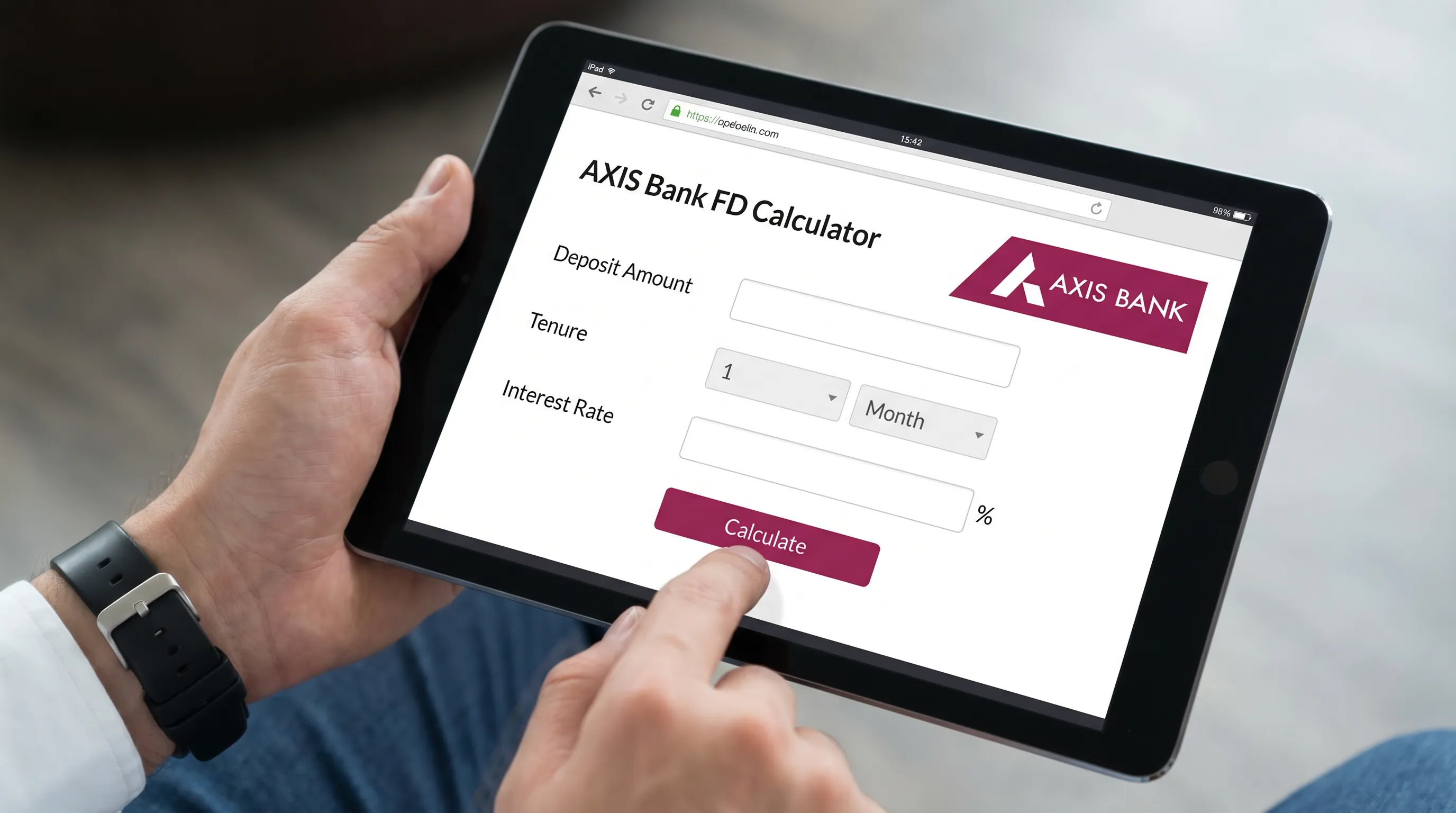
What is an Axis Bank FD Calculator?
An Axis Bank FD Calculator is a free online tool. It helps you estimate how much your fixed deposit will grow over time.
You simply enter a few details. The calculator instantly shows you:
- The total interest you will earn
- The final maturity amount
- A clear breakdown of your returns
It sounds simple.
Manual Calculation vs Online Calculator
Before online calculators existed, people had to calculate FD returns by hand. That process was slow and error-prone. The formula for compound interest looks like this:
A = P × (1 + r/n)n×t
Where:
- A = Maturity amount
- P = Principal amount
- r = Annual interest rate
- n = Number of times interest is compounded per year
- t = Tenure in years
This calculation is honestly quite confusing. One small mistake and the result is completely wrong.
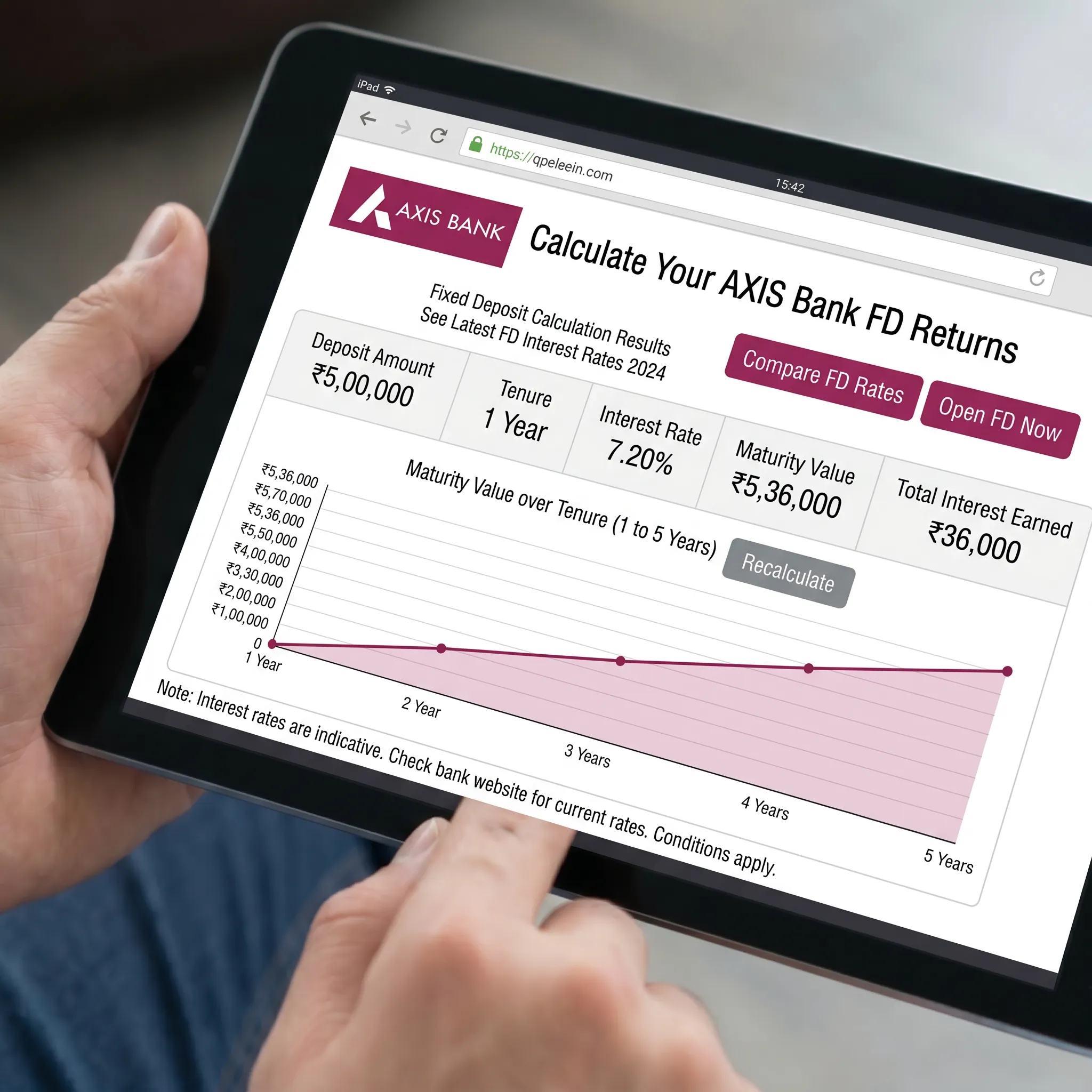
How Does the Axis Bank FD Calculator Work?
The process is straightforward. Here is how it works step by step:
- Step 1: Go to the Axis Bank FD Calculator page.
- Step 2: Select your customer category — Regular Citizen or Senior Citizen.
- Step 3: Choose your FD type — Regular, Digital, Tax-Saver, or FD Plus.
- Step 4: Enter your deposit amount and preferred tenure.
- Step 5: The calculator instantly displays your interest rate, total interest earned, and final maturity value.
The Role of Compounding Frequency
Here is something many investors miss. Axis Bank applies quarterly compounding on deposits with tenures of more than 6 months. This means your interest is calculated and added to your principal every three months. As a result, your money grows faster than it would with simple annual compounding.
For example, ₹1,00,000 invested at 6.60% for 3 years with quarterly compounding grows to approximately ₹1,21,699 at maturity. That is a solid return for a completely risk-free investment.
Key Features of the Axis Bank FD Calculator
The Axis Bank FD Calculator is packed with useful features. Here is what makes it stand out:
- Instant results — No waiting. You receive your maturity value in seconds.
- Accurate calculations — Based on the bank's official interest rates.
- Multiple FD types — Works for Regular FD, Digital FD, Tax-Saver FD, FD Plus, and Auto FD.
- Senior citizen rates — Automatically adjusts for the higher senior citizen rate.
- Flexible tenure options — Calculate for any tenure from 7 days to 10 years.
- No cost — Completely free to use.
- No login required — Anyone can use it without creating an account.
Additionally, the calculator works well on mobile devices.
Benefits of Using the Axis Bank FD Calculator
Several benefits include:
1. Saves Time
Manual FD calculations are time-consuming. The online calculator, on the other hand, gives results in under 5 seconds.
2. Eliminates Errors
Compound interest involves multiple variables. Even a small mistake in manual calculation can lead to a wrong result. The calculator eliminates this risk entirely.
3. Helps You Plan Better
When you know the exact maturity amount in advance, you can plan your finances more confidently. For instance, you can plan for a child's education, a home purchase, or retirement savings.
4. Enables Comparison
You can try different amounts, tenures, and rate scenarios. As a result, you can pick the combination that gives you the best return for your goal.
India's bank deposits grew by 9.75% year-on-year to over ₹2,46,77,712 crore by October 2025. Clearly, millions of Indians are trusting FDs with their savings. Using a calculator ensures you get the most out of every rupee invested.
Types of Fixed Deposits Offered by Axis Bank
Axis Bank does not offer just one type of FD. In fact, it offers multiple options to suit different financial goals. Here is a quick overview:
1. Regular Fixed Deposit
- Minimum deposit: ₹5,000
- Tenure: 7 days to 10 years
- Best for: General savings and wealth building
2. Digital Fixed Deposit
- Can be opened without an Axis Bank account
- One free premature withdrawal of up to 25% without penalty
- Best for: New customers and digital-first investors
3. Tax-Saver Fixed Deposit
- Minimum deposit: ₹100, maximum: ₹1.5 lakh
- Lock-in period: 5 years (no premature withdrawal)
- Tax deduction of up to ₹1.5 lakh under Section 80C
- Best for: Salaried individuals looking to save on taxes
For Section 80C rules, interest tax, and common mistakes, see Tax Saver FD Explained.
4. Fixed Deposit Plus
- For high-value deposits of ₹3 crore and above
- Higher interest rates than regular FDs
- Best for: HNIs and businesses
5. Auto Fixed Deposit
- Automatically sweeps surplus funds from your savings account into an FD
- Best for: People who want to earn FD-level interest on idle savings
Factors That Affect Your FD Returns
Not all FDs are equal. Several factors can impact how much you actually earn. Here is what you need to keep in mind:
1. Interest Rate
This is the biggest factor. Higher rates mean more returns. Rates are influenced by the RBI repo rate. Currently, the RBI has held the repo rate at 5.25%. This means rates are near their peak — making it a good time to lock in long-term FDs.
2. Tenure
Generally, longer tenures offer better rates. For example, a 5-year FD at Axis Bank earns 6.45% for regular citizens, compared to just 3.00% for brief tenures.
3. Compounding Frequency
Axis Bank uses quarterly compounding for FDs over 6 months. This is more beneficial than annual compounding. The more frequently interest is compounded, the higher your effective return.
4. Premature Withdrawal Penalty
Breaking an FD early costs you money. Axis Bank charges a 1% penalty on the applicable interest rate. Moreover, FDs closed within 7 days earn zero interest. Therefore, plan your tenure carefully before investing.
5. Customer Category
Senior citizens always earn more. They receive an additional 0.50% to 0.75% above the regular rate across all tenures.
Axis Bank FD Interest Rates (Latest Updates — April 2026)
Interest rates are the most important factor in any FD investment. Here are the latest Axis Bank FD rates, effective from April 7, 2026:
For Regular Citizens (Below ₹3 Crore)
| Tenure | Interest rate |
|---|---|
| 7 days to less than 1 year | 3.00% – 6.25% |
| 1 year to less than 3 years | 6.25% – 6.45% |
| 3 years to less than 5 years | 6.45% |
| 5 years to 10 years | 6.45% |
For Senior Citizens (Below ₹3 Crore)
| Tenure | Interest rate |
|---|---|
| 7 days to less than 1 year | 3.50% – 6.25% |
| 1 year to less than 3 years | 6.75% – 6.95% |
| 3 years to less than 5 years | 6.95% |
| 5 years to 10 years | 7.20% |
Key Highlights
- Senior citizens earn 0.50% to 0.75% more than regular citizens across all tenures.
- The highest rate for regular citizens is 6.45% per annum.
- The highest rate for senior citizens is 7.20% per annum.
- A senior citizen investing ₹5,00,000 at 7.20% for 10 years gets a maturity value of approximately ₹10,02,116 — effectively doubling their money.
Additionally, rates are subject to change without prior notice. Always confirm the latest published rates with your bank before investing.
Example: Calculate FD Returns Using the Axis Bank FD Calculator
Let us make this practical. Here is a sample calculation for a principal of ₹1,00,000 across different tenures at current rates (quarterly compounding):
| Principal | Tenure | Rate (general) | Approx. maturity amount |
|---|---|---|---|
| ₹1,00,000 | 1 Year | 6.25% | ~₹1,06,398 |
| ₹1,00,000 | 3 Years | 6.45% | ~₹1,21,159 |
| ₹1,00,000 | 5 Years | 6.45% | ~₹1,37,800 |
| ₹1,00,000 | 10 Years | 6.45% | ~₹1,89,000 |
These are indicative figures. The actual maturity amount may vary slightly.
Quick Tip: The Rule of 72
Want to know how long it takes to double your money? Use the Rule of 72. Simply divide 72 by the interest rate.
- At 6.45% → Your money doubles in about 11.2 years
- At 7.20% → Your money doubles in about 10 years
This is a quick mental shortcut that every investor should know.
Axis Bank vs other banks (illustrative)
On comparable retail buckets, Axis Bank often sits in the same band as other large private banks. Use the table as a conversation starter, then re-check each bank’s live card.
| Bank | Indicative range |
|---|---|
| Axis Bank | ~6.35% – 6.70% (varies by tenor) |
| HDFC Bank | ~6.25% – 6.60% |
| ICICI Bank | ~6.30% – 6.55% |
| SBI | ~6.20% – 6.50% |
Who Should Use the Axis Bank FD Calculator?
The short answer is: everyone who wants to invest in an FD. But more specifically, here is who benefits the most:
- First-time investors — Understand returns before committing any money.
- Salaried individuals — Plan tax-saving FDs under Section 80C.
- Retirees and senior citizens — Estimate monthly or quarterly income from non-cumulative FDs.
- Parents — Plan for children's education goals with a clear maturity figure.
- Business owners — Park surplus funds for short periods and calculate exact returns.
Remember, 80% of all term deposits in India fall in the ₹15 lakh to ₹1 crore range. These are people who need precise calculations to make the right decision. The FD calculator helps them do exactly that.
Tips to Maximize Your FD Returns
Getting a good interest rate is just the start. Here are proven strategies to squeeze the most out of your Axis Bank FD:
1. Lock In Now While Rates Are High
The RBI repo rate is currently at 5.25%. Rates are at or near their peak. If inflation drops later in 2026, the RBI may cut rates. So locking in a long-term FD now is a smart move.
2. Use the FD Laddering Strategy
Do not put all your money in one FD. Instead, split it across multiple FDs with different tenures. For example, divide ₹3,00,000 like this:
- ₹1,00,000 in a 1-year FD
- ₹1,00,000 in a 2-year FD
- ₹1,00,000 in a 3-year FD
When the 1-year FD matures, reinvest it into a new 3-year FD. Over time, all your money moves into long-term FDs earning the highest rates. Meanwhile, one FD matures every year, giving you annual liquidity.
3. Spread Across Banks to Avoid TDS
TDS at 10% is deducted if your FD interest at one bank exceeds ₹40,000 per year (or ₹50,000 for senior citizens). By spreading your FDs across banks, you can keep the interest at each bank below the threshold — and potentially avoid TDS altogether.
4. Senior Citizens: Always Choose Senior Citizen Rates
If you are 60 or above, always select the senior citizen category. The extra 0.50% to 0.75% may seem small. But over a 5-year or 10-year FD, it adds to a significant difference.
5. Choose Cumulative FDs for Maximum Growth
If you do not need regular income, go with the cumulative option. Here, interest is compounded and added to your principal. As a result, you earn interest on interest — which significantly boosts your maturity amount over time.
6. Use DICGC Insurance Wisely
Deposits up to ₹5 lakh per depositor per bank are insured by DICGC. By spreading your investments across multiple banks, you can maximize your insurance coverage on larger sums.
Frequently asked questions
1. What is the Axis Bank FD Calculator?
The Axis Bank FD Calculator is an online tool that helps you estimate the maturity amount and interest earned on your fixed deposit based on the latest interest rates.
2. How can I use the Axis Bank FD calculator online?
You simply enter your deposit amount, tenure, and applicable interest rate. The calculator will instantly show your total returns and interest earned.
3. What are the latest Axis Bank FD interest rates in 2026?
Axis Bank FD interest rates vary based on tenure and customer type (regular or senior citizen). Short-term and long-term deposits have different rate slabs, which are updated periodically.
4. Does the Axis Bank FD calculator include compound interest?
Yes, the calculator considers compound interest, usually compounded quarterly, to give you an accurate estimate of your FD returns.
5. Can I calculate monthly interest payouts using the Axis Bank FD calculator?
Yes, the calculator allows you to estimate monthly, quarterly, or cumulative payouts depending on the FD type you choose.